

What If the At‑Fault Driver Has No Insurance in Michigan?
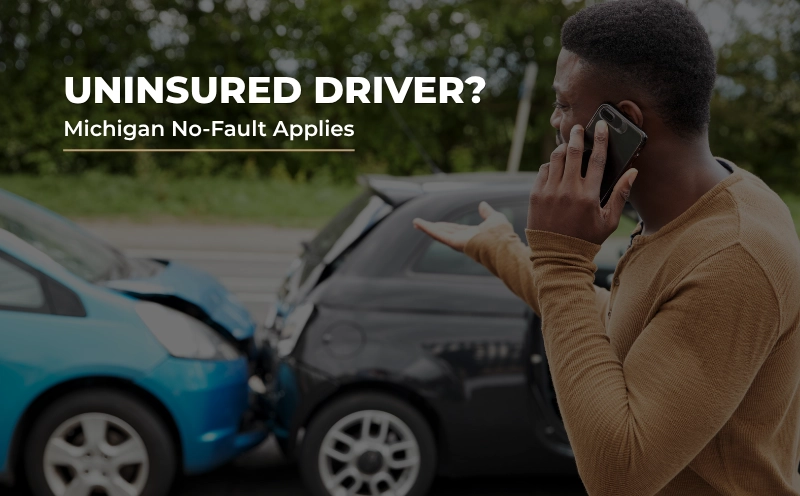
If the at‑fault driver has no insurance in Michigan, your own no‑fault insurance still applies for medical and wage‑loss benefits. Additional compensation may be available through uninsured or underinsured motorist coverage if your policy includes it, particularly when injuries are serious.
After a car accident, many injured drivers assume the at‑fault driver’s insurance company will pay for medical bills, lost wages, and other damages. In Michigan, however, a surprising number of crashes involve drivers with no insurance or not enough insurance to fully cover the harm they cause.
When the at‑fault driver is uninsured – or underinsured – injured victims are often left confused about who pays for medical care, how no‑fault benefits apply, and whether additional compensation is available.
Understanding what happens when the at‑fault driver has no insurance in Michigan is critical to protecting your recovery.
How Common Uninsured Drivers Are in Michigan
Although Michigan law requires drivers to carry auto insurance, uninsured and underinsured motorists remain a significant problem statewide. Accidents involving uninsured drivers frequently occur in:
- Hit‑and‑run situations
- Urban traffic corridors
- Late‑night or early‑morning crashes
- Construction zones
- Situations involving suspended or expired policies
In many cases, injured people do not discover the at‑fault driver is uninsured until days or weeks after the crash – often after medical treatment has already begun.
What Happens If the At‑Fault Driver Has No Insurance?
When the driver who caused the accident has no insurance, the focus shifts to your own policy.
Michigan’s no‑fault system still applies even if the at‑fault driver is uninsured. That means you may still receive benefits such as:
- Medical expense coverage
- Wage loss benefits
- Replacement services
These benefits can be critical in the early stages of recovery, but they do not compensate for pain and suffering or long‑term quality‑of‑life losses.
When injuries are serious, additional options may be available.
Uninsured Motorist (UM) Coverage Explained
Uninsured Motorist (UM) coverage is optional in Michigan, but it is one of the most important protections drivers can have.
When the at‑fault driver has no insurance – or flees the scene – UM coverage may allow injured victims to pursue compensation for:
- Pain and suffering
- Emotional distress
- Loss of enjoyment of life
Michigan’s uninsured motorist benefits vary significantly depending on policy language, coverage limits, and notice requirements. These details often determine whether a UM claim succeeds or is denied.
Full Overview: Uninsured Motorist Benefits
UM claims are typically made against the injured person’s own insurance company and often resemble traditional personal injury cases.
Underinsured Motorist (UIM) Coverage
Underinsured Motorist (UIM) coverage applies when the at‑fault driver has insurance, but not enough to fully compensate the injured person.
This situation commonly arises when:
- The at‑fault driver carries minimum policy limits
- Those limits are quickly exhausted
- The injured person’s damages are extensive
Michigan underinsured motorist claims typically arise only after the at‑fault driver’s insurer tenders its full policy limits, making timing and execution especially important.
Detailed Explanation: Underinsured Motorist Claims
Why UM and UIM Claims Are Often Disputed
Many injured people are surprised to learn that their own insurance company may aggressively dispute UM or UIM claims.
Common disputes include:
- Fault for the accident
- Severity of injuries
- Medical treatment necessity
- Whether injuries qualify as “serious”
These disputes often mirror the same tactics insurers use in third‑party injury cases.
For broader context, see: Common Insurance Tactics Used to Reduce Michigan Injury Claims
Serious Injuries and Uninsured Driver Accidents
Uninsured driver crashes frequently involve serious injuries, particularly in high‑speed or hit‑and‑run scenarios.
When injuries rise to the level of a serious impairment of body function, additional legal options may become available.
For a detailed explanation of that threshold, see: What Is “Serious Impairment of Body Function” Under Michigan Law?
Whether suing the uninsured driver directly makes sense often depends on whether the driver has collectible assets.
Can You Sue an Uninsured Driver Directly?
In most cases, yes – but practical considerations matter.
Many uninsured drivers lack sufficient assets to pay a judgment, which can make lawsuits:
- Costly
- Time‑consuming
- Ultimately unproductive
As a result, insurance‑based recovery through UM or UIM coverage is often the most realistic option.
Hit‑and‑Run Accidents and Insurance Coverage
Hit‑and‑run crashes present unique challenges. When the at‑fault driver cannot be identified, UM coverage often becomes essential.
In hit‑and‑run cases:
- Police reports are critical
- Prompt notice to your insurer is required
- Policies may impose strict reporting deadlines
Failing to follow these steps can jeopardize coverage.
Recorded Statements in Uninsured Driver Claims
Insurance companies often request recorded statements in uninsured and underinsured driver claims, especially when coverage questions exist.
Statements may later be used to:
- Challenge fault
- Minimize injuries
- Delay or deny coverage
For guidance on handling these requests, see: Should You Give a Recorded Statement After a Michigan Car Accident?
How Accident Type Can Affect Uninsured Claims
Distracted Driving Accidents: Hit‑and‑run crashes frequently involve distracted drivers attempting to avoid responsibility.
Construction Zone Accidents: Uninsured drivers involved in work‑zone crashes create layered liability and coverage issues.
Semi‑Truck Accidents: Uninsured coverage disputes are less common in truck cases, but coverage coordination issues still arise.
Steps to Take After an Accident With an Uninsured Driver
If you believe the at‑fault driver is uninsured:
- Obtain a police report
- Gather witness information
- Document the scene thoroughly
- Notify your insurer promptly
- Seek medical attention
- Avoid informal agreements or speculative statements
Early missteps can limit available coverage.
Why Early Legal Evaluation Matters
Uninsured and underinsured motorist claims are technical and highly procedural. Early legal evaluation can help:
- Identify applicable UM/UIM coverage
- Ensure notice requirements are met
- Preserve serious injury claims
- Avoid coverage disputes
- Protect long‑term recovery
Delays often benefit insurance companies, not injured people.
Frequently Asked Questions
Q. Will no fault insurance still pay if the other driver is uninsured?
A. Yes. No fault benefits generally apply regardless of the other driver’s insurance status.
Q. Do I automatically have UM or UIM coverage?
A. No. UM and UIM coverage are optional and depend on your policy.
Q. Can my own insurer deny a UM or UIM claim?
A. Yes. Insurers often dispute fault, injury severity, or coverage terms.
Speak With a Michigan Car Accident Lawyer About Uninsured Driver Claims
Accidents involving uninsured or underinsured drivers often involve multiple layers of insurance law and strict procedural requirements. Understanding your options early can make a significant difference in recovery.
If you were injured by an uninsured driver in Michigan, our free consultation can clarify which benefits may be available and how best to protect your rights.
With offices across Michigan, an experienced car accident lawyer is always nearby – serving clients in Lansing, Grand Rapids, Kalamazoo, Ann Arbor, and throughout Metro Detroit.