
Facebook

Instagram

LinkedIn

YouTube

What Evidence Matters Most in a Michigan Car Accident Claim?

Stack of legal case files and a judge’s gavel representing evidence in a car accident claim.

The most important evidence in a Michigan car accident claim usually includes medical records, photographs and video, witness statements, police reports, proof of financial loss, and any documentation that connects the injury and its life impact back to the crash. The strongest claims are built on evidence that proves fault, causation, injury seriousness, and damages in a consistent way. After a Michigan car accident, most people understand that evidence matters - but many are not sure which evidence matters most or how different pieces of evidence affect different parts of a claim. Some evidence helps show who caused the crash. Other...

Continue reading

How Long a Michigan Car Accident Case Takes (and Why It Varies)

Judge’s gavel with two vehicles representing the process of a Michigan car accident claim.

A Michigan car accident case can take anywhere from a relatively short insurance claim process to a much longer lawsuit timeline, depending on injury severity, medical treatment, fault disputes, insurance issues, and whether the case resolves in negotiation, mediation, or trial. There is no one standard timeline because every case develops differently. After a Michigan car accident, many injured people want a clear answer to one practical question: How long is this going to take? That question makes sense. Medical treatment may already be underway, bills may be arriving, work may be disrupted, and the insurance company may be asking for statements or...

Continue reading

Can Gaps in Medical Treatment Hurt Your Michigan Injury Claim?

Medical professional reviewing treatment notes with a patient in a clinical setting.

Yes, gaps in medical treatment can hurt a Michigan injury claim because insurance companies often use them to argue that the injury was not serious, was not caused by the accident, or did not meaningfully affect the injured person’s normal life. Treatment gaps do not automatically destroy a claim, but they often make serious injury and causation issues harder to prove. After a Michigan car accident, many injured people do what seems reasonable: they get checked out, try to rest, and hope things improve. Some begin treatment right away but stop after a few visits because work gets busy, appointments are...

Continue reading

Lansing Car Accidents: What Happens If You’re Partially At Fault?

Traffic at a Lansing intersection representing shared fault in a car accident.

If you are partly at fault in a Lansing car accident, you may still be able to recover compensation under Michigan law. However, your recovery can be reduced by your percentage of fault, and if you are found to be more than 50% at fault, certain damages - including pain and suffering in many cases - may no longer be available. After a car accident in Lansing, one of the first things many injured drivers worry about is whether something they did - even something small - could hurt their case. Maybe they were driving a little too fast. Maybe they...

Continue reading

What Happens If You’re Partly At Fault in a Michigan Car Accident?

Two vehicles close together on a roadway representing shared fault in a Michigan car accident.

In Michigan, you can still recover compensation after a car accident if you were partly at fault - but your recovery may be reduced by your percentage of fault. If you are more than 50% at fault, you may be barred from recovering certain damages, including pain and suffering in many cases. After a car accident, one of the first questions many injured people ask is: What happens if the insurance company says I was partly at fault? In Michigan, this is a critical issue because partial fault can directly affect both whether you can recover compensation and how much compensation...

Continue reading

Celebrating Mike Larkin’s Retirement

Portrait of attorney Mike Larkin featured in a Sinas Dramis Law Firm retirement and recognition announcement

Honoring an extraordinary career, quiet leadership, and the lasting difference Mike made for clients, colleagues, and friends at the firm. On June 1, 2026, Michael (“Mike”) E. Larkin retired from the Sinas Dramis Law Firm, bringing to a close a remarkable legal career defined by exceptional advocacy, professionalism, and a deep commitment to helping others. Mike was born and raised in Tucson, Arizona. He earned his undergraduate degree in Government and International Relations from the University of Notre Dame in 1979 and received his law degree from the University of Arizona Law School in 1982. He began his legal career with Haralson,...

Continue reading

What If the At‑Fault Driver Has No Insurance in Michigan?

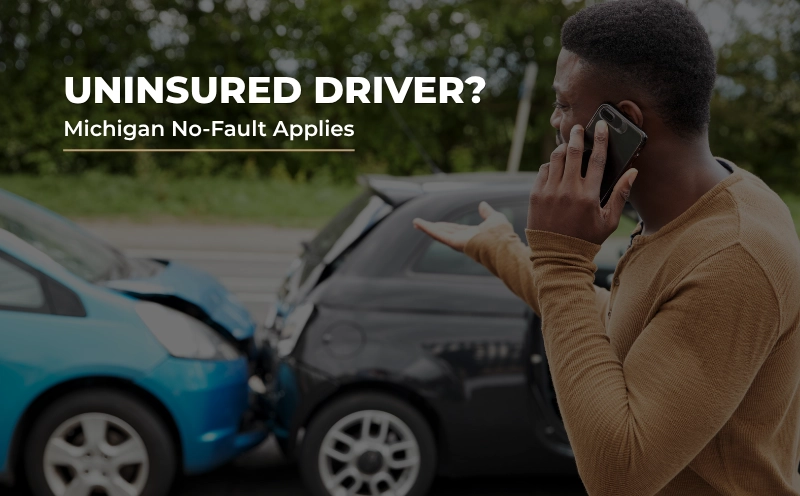
Car accident involving an uninsured driver in Michigan, with explanation that No-Fault insurance still applies

If the at‑fault driver has no insurance in Michigan, your own no‑fault insurance still applies for medical and wage‑loss benefits. Additional compensation may be available through uninsured or underinsured motorist coverage if your policy includes it, particularly when injuries are serious. After a car accident, many injured drivers assume the at‑fault driver’s insurance company will pay for medical bills, lost wages, and other damages. In Michigan, however, a surprising number of crashes involve drivers with no insurance or not enough insurance to fully cover the harm they cause. When the at‑fault driver is uninsured - or underinsured - injured victims are often...

Continue reading

Who Can Be Held Liable in a Michigan Semi‑Truck Accident?

Semi truck traveling on Michigan highway, representing liability factors in truck accident cases

In a Michigan semi‑truck accident, liability may extend beyond the truck driver to include the trucking company, cargo loaders, maintenance contractors, or vehicle manufacturers. Michigan law allows injured victims to pursue claims against all parties whose negligence contributed to the crash. When a semi-truck accident happens, determining who is legally responsible is not always straightforward. Unlike a typical car crash, multiple parties may be involved - from the truck driver to the trucking company, a maintenance provider, or even a third-party contractor. Each of these parties may play a role in how the crash occurred and who ultimately bears legal responsibility. Understanding...

Continue reading

Can You Sue a Distracted Driver in Michigan? What No‑Fault Insurance Really Allows

Driver using a smartphone while driving in Michigan, illustrating distracted driving and potential accident liability

After a car accident in Michigan, injured drivers are often told the same thing: “Michigan is a no‑fault state, so you can’t sue the other driver.” This belief is especially common in distracted driving cases, where fault may seem obvious but the rules around compensation are widely misunderstood. In reality, Michigan’s no‑fault system does not eliminate all lawsuits. While no‑fault insurance applies first and provides important benefits, Michigan law still allows injured victims to pursue additional compensation when a distracted driver causes serious injury. Understanding when you can sue - and when you cannot - is critical to protecting your recovery after...

Continue reading

What to Do After a Car Accident in Lansing When Injuries Aren’t Immediately Obvious

Man experiencing neck pain after a car accident on a Lansing roadway with vehicle damage nearby

Not all car accident injuries are immediate. In Lansing, many drivers leave crash scenes believing they are “fine,” only to develop pain, stiffness, headaches, or neurological symptoms days or even weeks later. These delayed injuries often lead to insurance disputes and denied claims - not because the injuries aren’t real, but because victims didn’t know what to do early on. This guide explains how Michigan law treats delayed car accident injuries and what Lansing drivers should do to protect their health and legal rights. Key Takeaways Delayed symptoms after car accidents are medically common and legally recognized Michigan law does not require immediate...

Continue reading