

Multi‑Vehicle Car Accidents in Grand Rapids: Liability, Insurance & Legal Challenges
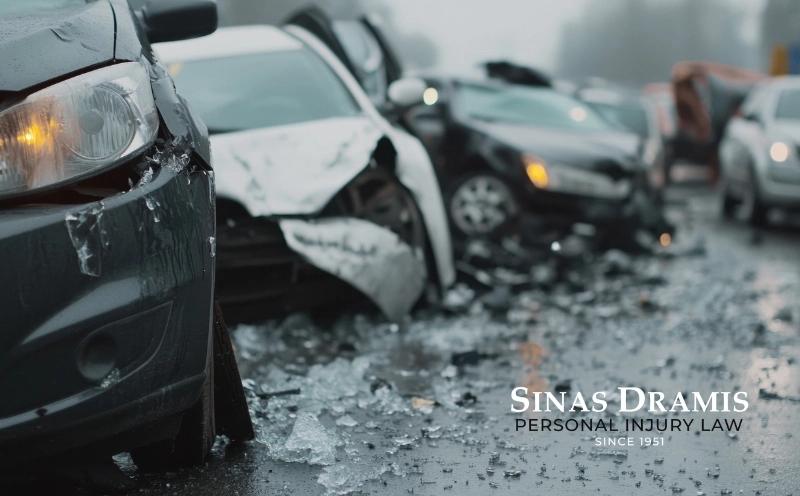
Multi‑vehicle car accidents are among the most legally complex personal injury cases in Grand Rapids. Unlike two‑car collisions, chain‑reaction and pileup crashes often involve disputed liability, multiple insurers, and conflicting witness accounts. For injured victims, understanding how Michigan law handles fault, insurance coverage, and compensation after a multi‑vehicle crash is essential to protecting their rights and recovery.
Key Takeaways
- Multi‑vehicle accidents often involve shared or disputed liability
- Michigan’s comparative fault rules directly affect compensation
- Insurance coverage disputes are common and delay recovery
- Early evidence collection is critical in Grand Rapids pileups
- These cases are rarely straightforward and often undervalued
Why Are Multi‑Vehicle Accidents So Complicated?
Multi‑vehicle accidents are complicated because fault may be shared among several drivers, evidence is conflicting, insurers shift blame, and Michigan’s comparative negligence system reduces compensation based on assigned fault percentages.
What Is a Multi‑Vehicle Car Accident?
Defining Multi‑Car and Chain‑Reaction Crashes
A multi‑vehicle accident involves three or more vehicles and typically occurs when:
- One collision triggers subsequent impacts
- Sudden stopping leads to chain‑reaction rear‑ends
- Multiple lanes are involved in highway congestion
In Grand Rapids, these crashes commonly happen on US‑131, I‑196, and busy arterial roads.
How many cars make an accident “multi‑vehicle”?
Any crash involving three or more vehicles is considered a multi‑vehicle or chain‑reaction accident.
Common Causes of Multi‑Vehicle Accidents in Grand Rapids
Sudden Stops and Heavy Traffic
Rush‑hour congestion frequently leads to chain‑reaction rear‑end crashes when drivers follow too closely.
Weather‑Related Conditions
Rain, fog, and winter weather cause:
- Reduced stopping distances
- Visibility issues
- Secondary impacts after initial collisions
Distracted or Aggressive Driving
Texting, speeding, and abrupt lane changes often trigger the initial impact that escalates into larger crashes.
Determining Liability in Multi‑Vehicle Crashes
Michigan’s Comparative Fault System
Michigan applies a comparative negligence system. Each driver may be assigned a percentage of fault.
This directly affects compensation, a concept frequently misunderstood in Grand Rapids car accident injury claims involving multiple vehicles.
Can more than one driver be liable in a multi‑vehicle accident?
Yes. Michigan law allows fault to be divided among multiple drivers based on their role in causing the crash.
Chain‑Reaction Liability Scenarios
Common scenarios include:
- The first driver causing sudden braking
- Multiple following drivers failing to stop
- Secondary impacts from adjacent lanes
Each driver’s actions are evaluated independently.
How Police Reports and Crash Reconstructions Are Used
Limits of Police Reports
While police reports are helpful, they:
- Are not legally binding
- May omit critical details
- Often rely on incomplete statements
Accident Reconstruction in Serious Cases
Reconstruction experts analyze:
- Vehicle damage patterns
- Skid marks
- Event data recorders
These tools are often decisive in contested Grand Rapids car crashes with multiple defendants.
Insurance Challenges in Multi‑Vehicle Accidents
Multiple Insurance Carriers
Each at‑fault driver’s insurer will:
- Minimize its client’s responsibility
- Shift blame to others
- Dispute injury causation
Priority and Coverage Issues
Michigan no‑fault rules govern:
- Personal Injury Protection (PIP) benefits
- Order of insurer responsibility
Disputes may delay payment for medical treatment and lost wages.
Who pays medical bills after a multi‑car accident in Michigan?
Your own no‑fault insurer typically pays PIP benefits, but disputes over priority can delay coverage.
Injuries Commonly Seen in Multi‑Vehicle Accidents
Severe and Repetitive Trauma
Occupants may sustain:
- Multiple points of impact
- Rotational spinal injuries
- Traumatic brain injuries
Psychological Injuries
Anxiety, PTSD, and sleep disturbance are common after pileups but often undervalued.
How Damages Are Calculated in Multi‑Vehicle Cases
Economic Damages
- Medical bills
- Future care
- Lost wages
- Reduced earning capacity
Non‑Economic Damages
- Pain and suffering
- Emotional distress
- Loss of enjoyment of life
Even when fault is shared, victims may still recover proportional compensation.
Common Insurance Defense Strategies
“Minimal Impact” Arguments
Insurers argue injury severity is inconsistent with damage.
Pre‑Existing Condition Claims
Adjusters frequently attribute pain to prior conditions rather than crash trauma.
Attorney insight:
These defenses routinely fail when medical records show symptom changes post‑accident.
Evidence That Strengthens Multi‑Vehicle Claims
Critical Evidence Types
- Dashcam footage
- Vehicle data recorders
- Independent witnesses
- Medical timelines
Early preservation is essential, particularly on highways like I‑196 where evidence disappears quickly.
Step‑by‑Step – What to Do After a Multi‑Vehicle Accident
Immediate Steps
- Seek medical attention
- Call law enforcement
- Photograph all vehicles
- Get witness information
- Notify your insurer
These steps mirror best practices outlined by our Grand Rapids car accident lawyersfor complex crashes.
Common Mistakes That Harm Multi‑Vehicle Claims
- Giving recorded statements too early
- Accepting early settlement offers
- Failing to document symptoms
- Assuming fault is settled
Local Factors Affecting Grand Rapids Multi‑Vehicle Cases
- Heavy commuter traffic patterns
- West Michigan weather conditions
- Limited shoulder space on highways
Local context shapes fault analysis and insurance evaluation.
When to Contact a Grand Rapids Car Accident Lawyer
You should seek legal help when:
- Multiple vehicles are involved
- Fault is disputed
- Injuries are ongoing
- Insurers delay or deny claims
Multi‑vehicle cases almost always exceed what victims can handle alone.
Frequently Asked Questions
Q. Who decides fault in a multi‑car accident?
A. Insurance companies argue fault, but courts decide if disputed.
Q. Can I recover if I was partially at fault?
A. Yes. Compensation is reduced based on percentage of fault.
Q. What if another driver is uninsured?
A. Uninsured motorist coverage may apply.
Q. How long do these cases take?
A. Longer than two‑car crashes due to complexity.
Q. Do I need a lawyer for multi‑vehicle accidents?
A. Strongly recommended due to disputed liability.
If you were injured in a multi‑vehicle crash and insurers are disputing fault or delaying benefits, understanding your legal options early can help preserve evidence and protect your recovery. Request your free consultation today.