

Who Can Be Held Liable in a Michigan Semi‑Truck Accident?
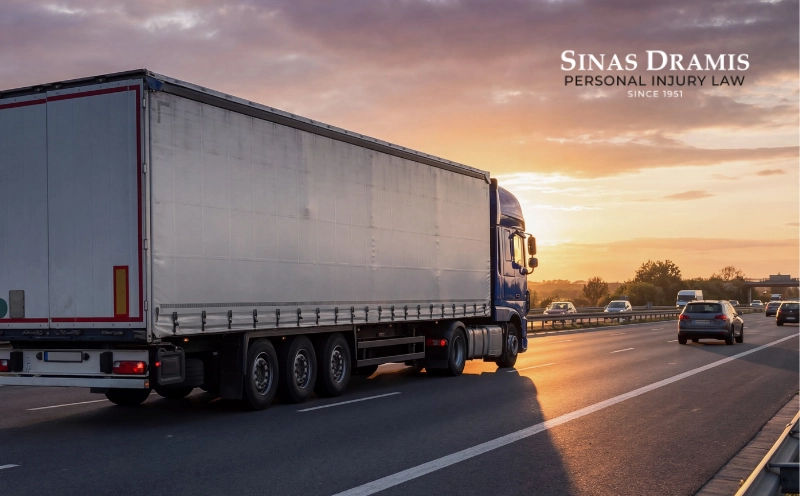
In a Michigan semi‑truck accident, liability may extend beyond the truck driver to include the trucking company, cargo loaders, maintenance contractors, or vehicle manufacturers. Michigan law allows injured victims to pursue claims against all parties whose negligence contributed to the crash.
When a semi-truck accident happens, determining who is legally responsible is not always straightforward. Unlike a typical car crash, multiple parties may be involved – from the truck driver to the trucking company, a maintenance provider, or even a third-party contractor. Each of these parties may play a role in how the crash occurred and who ultimately bears legal responsibility.
Understanding who can be held liable is only one part of the equation. It also helps to understand how these cases work at a broader level – especially how commercial vehicle crashes differ from other motor vehicle crashes in Michigan.
In this article, we explain who may be held liable after a Michigan semi-truck accident and why these cases often require a more detailed legal investigation.
Why Liability Is More Complex in Semi‑Truck Accidents
Unlike ordinary car accidents, semi‑truck crashes often involve:
- Commercial vehicles operated for profit
- Employers and corporate safety policies
- Federal trucking regulations
- High‑limit insurance policies
- Rapid, aggressive defense tactics
Because of these factors, responsibility is rarely limited to a single person. In many cases, liability is shared.
For a broader discussion of why truck cases differ from car accidents, see: Semi‑Truck Accidents in Michigan: Why These Cases Are Different
The Truck Driver
The truck driver is often the most visible participant in a semi‑truck accident and may be directly liable when the crash is caused by:
- Speeding or reckless driving
- Distracted driving
- Fatigue or hours‑of‑service violations
- Driving under the influence
- Failure to obey traffic laws
Commercial drivers are held to higher safety standards than regular drivers because of the size and danger posed by their vehicles. Even momentary inattention or rule violations can support a finding of negligence.
However, focusing solely on the driver often overlooks other responsible parties.
The Trucking Company (Employer Liability)
In many Michigan semi‑truck accident cases, the trucking company may be legally responsible under principles of employer liability. This means a company can be held accountable for negligent acts committed by a driver while performing job duties.
In addition to vicarious liability, trucking companies may also be directly liable when they:
- Hire unqualified or unsafe drivers
- Provide inadequate training
- Encourage unrealistic delivery schedules
- Fail to enforce hours‑of‑service rules
- Allow unsafe vehicles to remain in service
Company safety records, driver logs, and internal policies often play a central role in establishing this liability.
Cargo Loading Companies
Improperly loaded or secured cargo is a frequent cause of serious truck accidents. Poor loading can cause trucks to:
- Jackknife
- Tip or roll over
- Lose control during braking or turns
When a third‑party company is responsible for loading or securing cargo, that company may share responsibility for resulting crashes.
Federal regulations impose strict standards for cargo securement, and violations of those rules can significantly strengthen a negligence claim.
Maintenance and Repair Contractors
Commercial trucks require constant inspection and maintenance. In some cases, accidents are caused by mechanical failures rather than driver error.
Maintenance contractors may be liable when crashes result from:
- Brake failures
- Tire blowouts
- Steering malfunctions
- Failure to discover or repair known defects
Maintenance records and inspection logs are often critical evidence in these cases.
Truck or Parts Manufacturers
In some semi‑truck accidents, defective equipment plays a central role. Manufacturers may be held responsible when a crash is caused by:
- Defective brakes or tires
- Faulty steering components
- Manufacturing defects in critical systems
These cases may involve product liability claims in addition to negligence claims and often require expert technical analysis.
How Federal Trucking Regulations Affect Liability
Commercial trucking is governed by extensive federal regulations designed to promote roadway safety. Violations of these regulations frequently form the foundation of liability claims.
Common regulatory violations include:
- Hours‑of‑service violations (driver fatigue)
- Failure to conduct required inspections
- Missing or falsified driver logs
- Improper drug or alcohol testing
- Inadequate driver qualification files
When companies or drivers violate these rules, they may be held accountable for resulting harm.
How Michigan No‑Fault Insurance Interacts With Truck Accident Liability
Michigan’s no‑fault insurance system still applies in semi‑truck accidents. Injured victims typically receive no‑fault benefits through their own insurance policy, including:
- Medical expenses
- Wage loss benefits
- Replacement services
However, no‑fault benefits do not compensate for pain and suffering. When a semi‑truck accident causes serious injuries, additional claims may be available.
Serious Injuries and Multi‑Party Truck Claims
Semi‑truck accidents often involve injuries that significantly disrupt daily life. When injuries rise to the level of a serious impairment of body function, Michigan law allows injured victims to pursue third‑party claims against all responsible parties.
Insurance companies frequently dispute both liability and injury severity in these cases, making documentation essential.
Construction Zone Truck Accidents
Truck crashes frequently occur in construction zones, where narrowed lanes, reduced visibility, and sudden traffic changes increase risk.
In these cases, liability may involve:
- The truck driver
- The trucking company
- Road contractors or maintenance crews
Careful investigation is often required to untangle shared responsibility.
Why Identifying All Liable Parties Matters
Semi‑truck accident injuries are often severe and life‑altering. Limiting a claim to only one defendant can:
- Restrict available insurance coverage
- Reduce potential compensation
- Allow negligent parties to avoid accountability
Michigan law allows injured victims to pursue every party whose negligence contributed to the crash, which often makes a meaningful difference in recovery.
Common Defense Arguments in Truck Liability Cases
Trucking insurers and defense attorneys often attempt to:
- Shift blame to passenger vehicles
- Minimize injuries
- Argue regulatory compliance
- Dispute causation
These arguments are often part of broader insurance defense strategies.
Steps to Take After a Semi‑Truck Accident
If you are injured in a semi‑truck crash:
- Seek medical care immediately
- Ensure a police report is filed
- Photograph vehicles and the crash scene
- Identify witnesses
- Preserve communications and records
- Avoid recorded statements without guidance
Early steps can significantly affect the outcome of a truck accident claim.
Frequently Asked Questions
Q. Can more than one party be responsible for a truck accident?
A. Yes. Truck accidents often involve multiple defendants, including companies and contractors.
Q. Can I sue the trucking company even if the driver made the mistake?
A. Yes. Employers are often legally responsible for drivers’ actions.
Q. Do truck accidents follow the same rules as car accidents?
A. No. Truck accidents involve federal regulations and more complex liability analysis.
Speak With a Michigan Semi Truck Accident Lawyer
Determining who can be held liable in a Michigan semi truck accident requires careful investigation, knowledge of federal trucking regulations, and early evidence preservation.
If you were injured in a trucking accident, a free legal review can help identify every responsible party and determine whether compensation beyond no fault benefits may be available.